

Growth Does Not Just Happen. You Design It.
- MSN

- Aug 4
- 4 min read
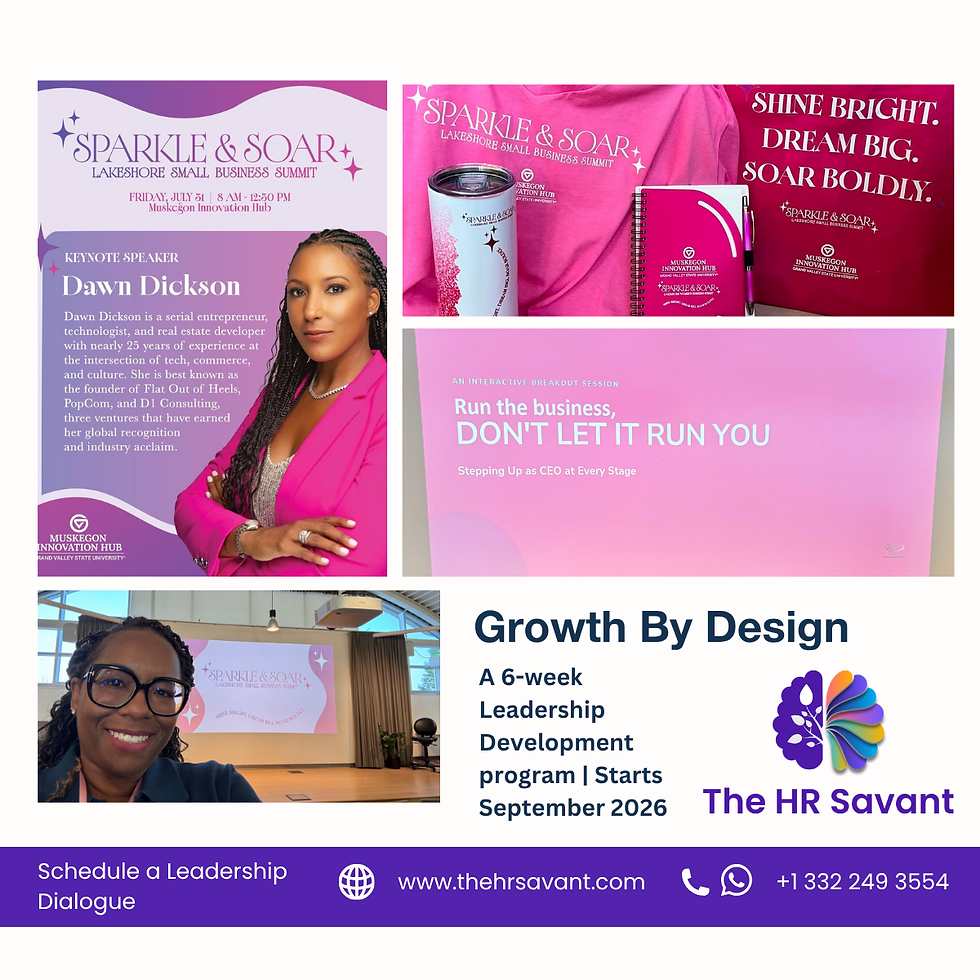
Last week, at Sparkle & Soar, I heard two lines that I have not stopped thinking about.
Dawn Dickson said, protect what you build with the same energy you used to build it. Leandra Nisbet said, run the business, do not let it run you. Different women, different businesses, same warning underneath. The energy that gets something started is not automatically the energy that sustains it. Somewhere between the founding and the future, a lot of leaders quietly stop building and start reacting.
I want to name why that happens, because I do not think it is a discipline problem. I think it is a design problem.
Growth by accident
Most professional growth is not designed. It is inherited.
You get better at the parts of the job that keep showing up, because repetition builds skill whether you intend it to or not. You get worse, or you simply stay where you started, at the parts nobody is forcing you to confront. Not because you are avoiding them. Because nothing in your week is built to surface them.
This is what I mean by growth by accident. It happens to you, shaped entirely by what your calendar demanded this quarter, rather than what your leadership actually needs next. A business owner who is a gifted closer becomes an even better closer, because every deal reinforces it. The same owner's blind spot around delegation stays exactly where it was five years ago, because nothing in the daily grind requires them to look at it directly.
Accidental growth is not nothing. It is real skill, honestly earned. But it is narrow, and it is chosen for you by circumstance, not by you.
The premise
Here is the premise I have built a practice on, and the one behind everything I am building this year. We grow only as far as we grow ourselves.
Not the business. Not the team. You. The ceiling on what you can build is not your market or your resources nearly as often as it is the leader running the whole operation. This is not a motivational line. It is closer to a mechanical fact. A business cannot become more intentional, more aligned, more resilient than the person leading it, because every decision in that business passes through that person's current capacity to see clearly and choose well.
Which means the highest leverage work available to most leaders is not a new hire, a new system, or a new strategy. It is becoming, deliberately, a slightly different version of the person currently running the operation. Growth by design instead of growth by accident.
What design actually requires
Intentional growth is not more effort. Plenty of exhausted leaders are working extremely hard at growth by accident, staying busy inside the parts of the job that already come easily to them, mistaking motion for development.
Design requires three things effort alone does not provide.
First, an accurate picture of where you actually are, not where you assume you are. Most leaders have a story about their own strengths and weaknesses that was accurate several years ago and has not been updated since. You cannot design a path forward from a map that is out of date.
Second, a structure that keeps the harder, less comfortable growth on the agenda. Left alone, most people's attention drifts back toward what is already working, because that is where the visible wins live. Real growth usually lives somewhere less comfortable, and it stays there unless something outside your own willpower keeps bringing you back to it.
Third, people who are not inside your business. Not because your team cannot see you clearly. Because they often cannot say what they see, for entirely reasonable reasons involving their own jobs and your approval. Growth by design tends to require a room, or a relationship, built specifically for the parts of you that your own organization has every incentive to leave unspoken.
The room I am building
This is the thinking behind Growth by Design, the six-week cohort I am opening this fall.
It begins with an honest, current picture, a DISC assessment and a private debrief that is a real conversation about what your patterns mean for how you lead, not a report you file away. It continues in six live sessions, not recordings, because intentional growth requires a structure that keeps showing up whether or not that week's calendar cooperates. It is built around a personal development plan shaped to what the debrief actually reveals about you, not a generic template applied to everyone in the room. The companion text is John Maxwell's The 15 Invaluable Laws of Growth, the same framework behind the Law of Intentionality this whole piece has been circling. This is not a book club. The book gives the room shared language. The six live sessions are where the actual work happens, alongside other business owners and professionals doing the same deliberate work, in the same room, in real time.
Dawn Dickson and Leandra Nisbet were both describing the same discipline from different angles. Protecting what you built. Running the business instead of being run by it. Underneath both is the same requirement. You have to keep growing on purpose, even after the thing you built is already working, because the version of you who built it is not automatically the version equipped to sustain it, let alone take it further.
Growth does not just happen. You have to design it.

If that is where you are right now, I would like to talk with you about it. Send me a message, or find a time that works for you here: https://www.coachaccountable.com/offering/PUKBn2TyWmQabGYQ3cDGdrabcIFOLLa.
Every relationship begins the same way, with a conversation.


Comments